The Origins of Poker
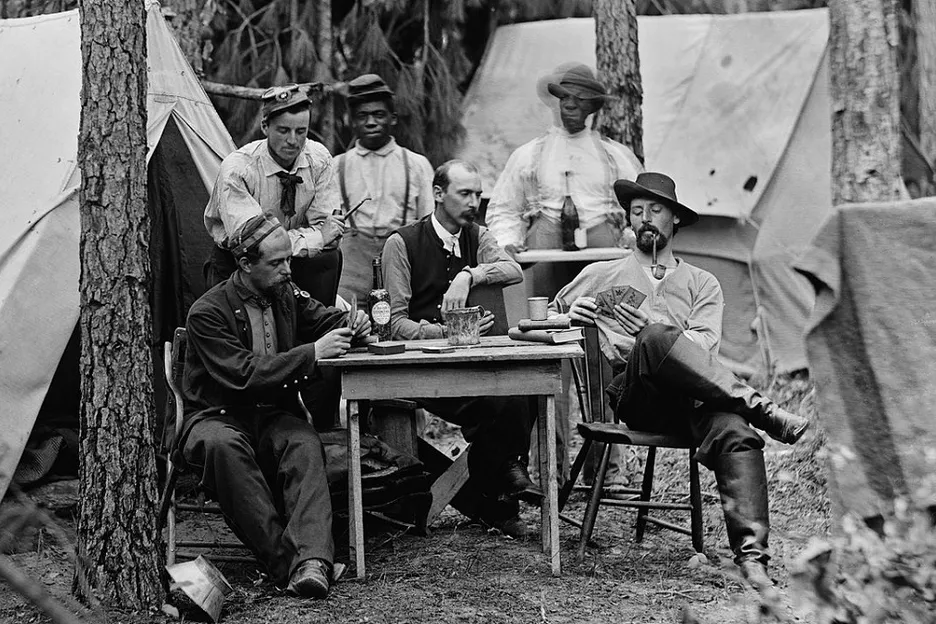
During much of its established history, most authorities assumed that the game of poker had an ancient and Persian origin. In 1895, for example, General Albert Houtum-Schindler had the following to say about the game of “As-Nas”:
“The game of As is exactly like Poker, but without any flushes or sequences. There are four players, and each player gets five cards, dealt to the right. The dealer puts down a stake. The first player then looks at his cards. If he “goes”, he says dîdam (I have seen), and covers the stake or raises it. If he does not wish to play, he says nadîdam, (I have not seen) and throws his cards. He may also “go” without looking at his cards – that is, in poker parlance, “straddle” – and says nadîd dîdam (not seeing, I have seen). The second player, if he wishes to play, must cover the stakes, and can also raise. The third player and the dealer then act in the same way just as in poker, and when the stakes of all players are equal and no one raises any more the cards are turned up and the player holding the best hand wins the stakes.”
Later work has cast doubt on this connection, compelling though it appears to be. In his tour de force “Cowboys Full: The Story of Poker,” author James McManus provides a beautiful and comprehensive description of how the great game of poker evolved to its current, well-known form. The back jacket includes the following summary of part of the material included in the book’s nearly 600 pages:
“It describes how early Americans took a French parlor game and turned it into a national craze by the time of the Civil War.”
The parlor game in question is “poque,” and, like McManus, most modern historians of poker assert confidently that it is the forerunner of poker. For example, Loomis and Malmuth state in “The Fundamentals of Poker” that:
“When French colonists arrived to settle the Louisiana Territory in the 1700s, they brought poque with them.”
The association between poque and poker is a natural one based purely on the spelling and sound of the word, but is that sufficient to determine a clear ancestry?
Poch, Pochen, Poque
The history of poker on American shores is less murky than its earlier origins. We know, based on an account by the English actor Joseph Cowell, that a game called poker was being played in New Orleans in 1829. A stripped twenty-card deck was used, with four players betting on who held the strongest five-card hand. Since the area was settled by the French, the connection to poque is strengthened.
So what are the rules of poque?
Fortunately, the game is still played today, predominantly in Germany, where it is known as poch or pochen. It boasts an impressively long history, being played in Strasbourg as early as 1441. Thus the next time you sit down at a poker table, you will be participating in a game that is nearly seven centuries old!
Except there’s a problem.
Beyond being played with standard playing cards, the modern game of poch has a somewhat tenuous connection to poker.
The first hole in the poch-to-poker narrative is readily apparent when one looks at the board (pochbrett) on which poch is played, an example of which is shown below.
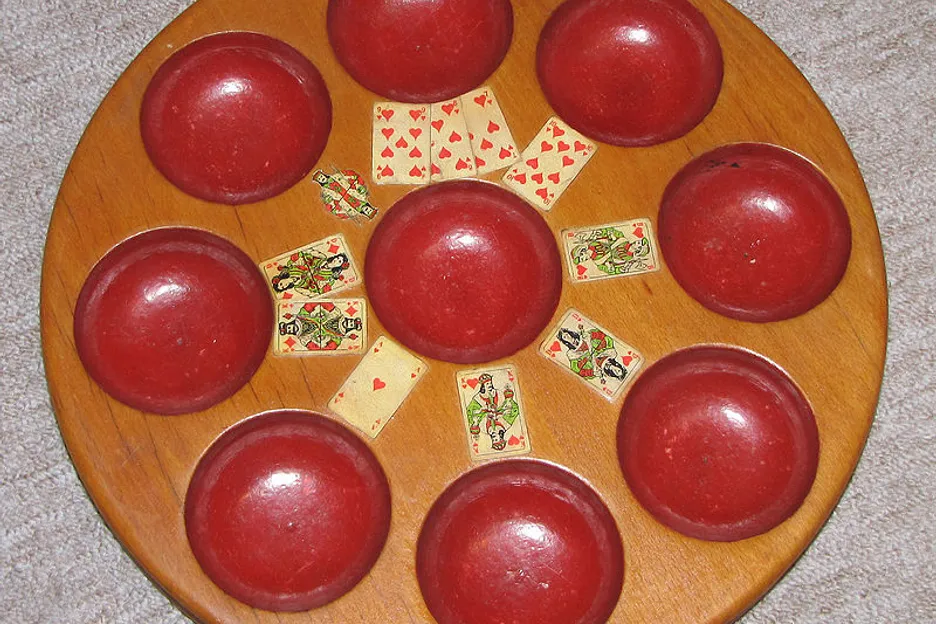
Source: Wikipedia/Aineias
The strange contraption becomes more comprehensible when placed in the context of the rules of poch. These are lengthy, but roughly speaking can be broken into four phases. Initially, each player places a chip in each of the “pools” on the pochbrett. Cards are then dealt, with the final one being turned face up. The suit of this card determines the “pay suit.” The initial round of play sees players claim the chips they have won by virtue of holding a card corresponding to the pay suit.
The second round is the part of the play where the game feels something like poker. Players take it in turns to bet on the value of their hand. The only hands that have value are, in conventional poker terminology, quads, trips and pairs. Also like poker, bluffing is possible, so that if a bet drives out all other players, the bettor wins any chips bet. In principle it is possible for this phase to result in no net gain for the “winner,” since no blinds or antes are used.
There are chips left over however, in the central pool of the pochbrett. These are won in the final phase when cards are played in sequence, such that if a player leads the jack of hearts, it is followed by the queen of hearts, and so on. The player who discards their entire hand first takes the central pot.
Is a Connection an Origin?
It is clear that most poker historians are satisfied with an ancestral connection between one phase of the fascinating game of poch/poque and the modern game of poker. And the similarity in names certainly adds weight to the idea that it arrived on the shores of Louisiana by French settlers.
The unsatisfying part of this narrative, however, is that in terms of European card games (not to mention the Persian game of As-Nas), there are a multitude of related candidates that have far closer thematic links to poker, and do so without the elaborate pochbrett.
Most notably, the card-game family that includes the Spanish primera, the Italian primiera and England’s primero all seem to descend from a common Italian ancestor: the game of gilet. The ancestral tree can be projected forward to include games such as the English “brag,” which is still played and is essentially indistinguishable from a three-card variant of poker.
Given that the pochbrett does not include any features used in the pokeresque phase of gameplay, it is even possible that poch absorbed those elements later in its evolution. In which case, poch and poque may have provided a name for our great modern card game, but the concept and rules have an independent origin.
The history of Texas Hold’em
By most accounts, the game of poker made its way from Europe to America via immigrants, gaining mainstream popularity in the 19th century. It became a favorite pastime in small town saloons and on Mississippi River boats, making its way through Middle America and to the West along with settlers and adventurers.
Texas hold’em was a particular variant that originated in Texas as a spin on the classic form of seven-card-stud poker and five-card-draw poker. Most historians trace Hold’em back to Robstown, Texas in the early 20th century, as recognized by the Texas legislature.
Poker players like Johnny Moss and Doyle Brunson traveled with the game from Texas to the further Wild West, landing in places like Nevada and California. As for Nevada, Felton “Corky” McCorquodale, now a member of the Poker Hall of Fame, introduced the game to the California Club there, where its popularity helped it spread to other Las Vegas casinos.
Texas hold’em made its way to the World Series of Poker in 1971 through Benny and Jack Binion, who pushed for it to become a primary determinant of the best players. With most players in agreement, the Binions used the game as the basis of the WSOP Main Event.
The popular variant held onto that position of honor, and eventually became the gold standard of poker tournaments from coast to coast. California card clubs soon adopted Texas hold’em, as did players across America looking for a standard variant.
The history of poker FAQs
When was poker invented?
Poker, as we know it today, has its origins in New Orleans in 1829. Although variations of the game were played before this, the poker played in New Orleans in the 1820s and 1830s was played with a stripped 20-card deck. The goal of the game was for four players to bet on who held the strongest five-card hand. It’s from this game that Texas Hold’em evolved.
Where and when did poker originate?
This is a difficult question to answer. Some people trace poker and other card games all the way back to ancient China. But specifically, poker can be reasonably traced to a game called “poque” that was played in the French colonies throughout the 1700s. But as mentioned here, the game was first called “poker” in the US in 1829, which is where many trace its origin story to.
What was poker called in the 1800s?
In the 1800s, poker went by various names, including “poch,” “pochen,” and “poque.” Poker is thought to be an Americanization of these terms, which German and French colonists primarily used to describe the game. Texas Hold’em and other modern variants didn’t come along until the early 20th century.
Who invented poker cards?
Poker cards – or playing cards more generally – are an invention of the Chinese. Cards can be traced to an ancient Chinese dynasty before the 10th century, showing just how old the notion of playing cards is! Playing cards were brought to Europe sometime in the 1360s and they were initially preserved for the rich, given the expense associated with their design and production.
What is the oldest card game?
The oldest card game still played today is a German game called Karnoffel. It was first played in 1426 and each game consists of 48 playing cards. The game originated in the southern state of Bavaria and is still a part of the gaming culture in Germany today. Karnoffel pre-dates poker by 400 years!
Featured image source: Library of Congress